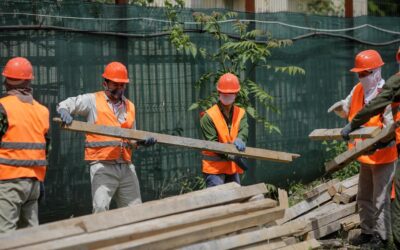
We see them every day, perhaps without paying enough attention to them: food deliverers, nannies, housekeepers, waiters, textile factory workers, as well as influencers or chefs at famous restaurants. Sometimes we marvel: Romania has been flooded with Asians, other times they are accused of "stealing jobs" that Romanians could receive. But which they don't want.
Antena 3 CNN and Antena3.ro are launching the "Immigrant in Romania" campaign on Monday, which will follow the stories of foreign workers who have chosen Romania as their home for the next few years or the rest of their lives.
From all corners of Asia and Africa, people fleeing poverty, violence, disease and death have come to Romania. Whether they are from Nepal, Sri Lanka, India, India, Vietnam, Ethiopia or Sudan, they are overwhelmingly male: more than 85% of foreign workers are men. They set off with one suitcase, or two at most, containing clothes, photos of their loved ones and some spices to keep them homesick on the other side of the world, in a country called Romania.
"This is our first child. I'm incredibly happy"
They have gone from wages of less than 100 dollars a month to 600-700 euros here. This is money to keep their families alive. Some of them have decided to stay in Romania because our country has given them what they would never have gotten in the place where they were born and raised.
Even though the road to Romania is long - literally and figuratively - immigrants keep coming. The money they earn here can be up to 10 times what they made in their home country.
This is also the case Isuru Laksan. Lake, as they call him here. Back home in Sri Lanka, he earned the equivalent of 800 lei a month. In Oradea, he earns 4,500 lei in a steering wheel factory.
On camera, Lake mixes Romanian and English. But he makes himself understood. He tells us that Romania and the Oradea community are home to him and his wife. At home in Sri Lanka, he has only his elderly mother. He had a brother who died.

And despite all the hardships, he has a huge reason to be happy these days: he is the father of a little boy called Alex, who is just over a month old. He's going to have him baptized in the Orthodox church. He will be the first Christian in the family. For the baby, he's renouncing Buddhism.
"This is our first child. I'm incredibly happy. At night it's a problem because we don't sleep, but I am very happy here. My baby is Romanian. We will baptize him here in the church. And we go to church every Sunday," says Lake.
"We will baptize the first baby born in our company"
His godfathers will be his bosses, who he says have helped him a lot over the years.
There are 51 employees from abroad working in the Oradea factory, and the company's founder, Valeriu Trip, has nothing but praise for them.
"Currently, we have reached 51 people who are here. Most of them are from Sri Lanka. They work in exceptional conditions. But they are also very good, and I am very happy with the work they are doing in the company. In a few weeks' time, we'll be baptizing the first Sri Lankan baby born in our company, he says.
"I tried, thinking I was far from home, to put myself in their shoes. To see what it would be like if someone could offer me a helping hand, being overseas. And that's what I tried to do for them. And I see their gratitude. That is why I have been and will be there for them." says Mihaela Blaga, deputy director of the company. She is also the baby's godmother.
In the home provided by the company, Lake's wife Shiromi takes her role as a mother seriously. The walls full of children's drawings and wedding photos are a testament to their happiness.
"I want my baby to grow up like a Romanian baby," says Shiromi Laksan.
What life is like for other foreign workers in Romania
Beyond the statistics, immigrant stories show that Romania is a country where immigrants not only find work, but also the chance of a new life - where hope, longing and solidarity give meaning to the long journey. And every child born or family reunited becomes part of a shared future.
"I have children and family here in Romania. Especially the children are Romanian", says Vietnamese restaurant manager Vini Dang.
Others, especially women, mothers, find it very hard to bear the separation from their children and dream of the day when they will return home. They have left their sons or daughters with whomever they can, knowing that they won't see them for years, when they can afford airfare.
"My life is there for them, but I'm very proud. I can't manage otherwise. I do it for their future: they are all in school, and I have to earn more to keep them in school," says Natchelle Lula, a masseuse from the Philippines.
"You are alone here. There's no one to look after you, to ask if you've eaten or if you're OK," says Nepalese Ray Khagendra.
"I learned Romanian very hard in my life, because it has masculine, feminine, neuter," explains Pita Said from Indonesia.
With some, Romania has been kind and made them homesick.
"I have many friends, customers. With some we become like brothers, like family," says Vini Dang.
"I feel safe here. Sometimes I go out at night on my day off. Here no one can touch you, no one can hurt you," believes Natchelle Lula.
You will see their stories on Antena 3 CNN and Antena3.ro in the coming days as part of the "Immigrant in Romania" campaign.