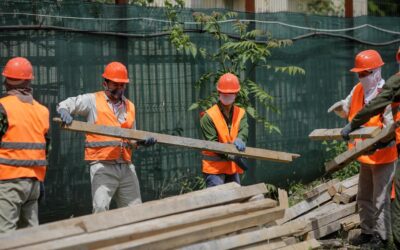
The shortage of construction workers in Romania is being felt, but to the benefit of Filipino workers. A leading recruitment agency has identified a solution to help tackle the shortfall in the sector. Both the Philippines and Romania in particular will benefit from a unique partnership.
Thousands of Filipino workers 'on loan' from Romania
Under an agreement between Romania's largest recruitment company and the Philippines, around 1,000 foreign skilled workers will be "borrowed" by our country in 2025. Simply put, it is a fixed period during which Filipino workers will work in Romania.
Agency representatives say that this temporary secondment will be much easier than permanent work, as there will be no need to obtain permits for the work. Staff brought in and hired by Philippine companies will come to Romania strictly for projects with a fixed duration.
"The process of borrowing foreign workers is based on an external partnership between our recruitment agency and construction companies to agree on certain terms, workers' wages, airfare, processing and accommodation costs, food and insurance, to name a few of the issues. We reach an agreement on those terms, and then we deal with getting the workers' approvalsexplains, for FANATIKYosef Gavriel Peisakh - General manager Work from Asia.
Benefits of the agreement bringing workers to Romania
This mechanism aims to help industry to complete ongoing projects in the country and reduce delays. Filipino workers, skilled and experienced in various construction specialties, will be directly assigned to projects where the need for employees is greatest. A big benefit is that the Philippines is directly responsible for each employee seconded to our country. Thus, Romanian beneficiaries are covered in terms of staff presence or performance.
"The advantage is that the workers are the employees of the foreign company, which saves Romanian employers many bureaucratic steps and processes. In this case, it is the Philippine company that is responsible for payroll and guaranteeing the presence of the workers on the job, the compatibility and performance of the staff with each job. It is a hybrid between leasing and staff placement. For example, when one of the workers runs away from the job, the company in the Philippines is obliged to replace him"says Yosef Gavriel Peisakh.
And for the Philippines it's a much easier process, with workers already employed by companies in the country. So there are no impediments to the process of recruiting and testing potential employees.
"For the Philippines it's much simpler because they already have the workers already employed, they already have the certainty of the performance of each individual worker, there is no need for separate recruitment and testing, it's just outsourcing. It's also easier for our partners in the Philippines to have the security to place their own staff and save the money that they would otherwise have involved in the whole recruitment and testing operation"continues the general manager.
Workers in the Philippines protected by international partnership
Another plus of posting Filipino workers to Romania is that the measure is in line with European rules on labor mobility. This agreement also protects workers and guarantees that their rights are respected.
"The workers have the advantage of stability and the guarantee that their wages are paid on time and that all other working conditions are respected, as all these are the responsibility of the employing company in the Philippines"said the head of the Asian recruitment company.
Yosef Gavriel Peisakh says the collaboration could be a good example for other areas of work where there is a shortage of staff.
"This model can be exactly replicated in other fields of activity, provided that the fields in question are regulated and there is a very high demand for staff"he says, for FANATIK.
In construction, there is an estimated shortage of around 150,000 workers. This number refers to the need to get big projects like highways, schools, hospitals and housing completed, but also to people in the sector who have retired or emigrated.