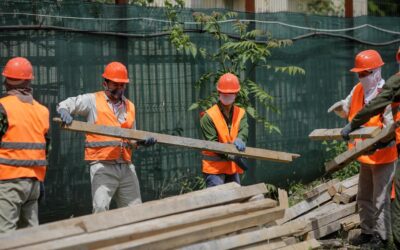
This summer, the construction sector recorded its highest number of employees since 2000, according to NSI data. These are employees with a work permit, not workers doing untaxed work.
With 430.2 thousand employees in August this year, it exceeded the peak of the boom year 2008 by more than 1%.
While the construction sector is employing a record number of people, it is also suffering from a shortage of workers, especially skilled workers.
Staff shortages have worsened over the past three years as the volume of construction work has soared.
In order to realize public investment projects, in addition to securing financing, the Government has had to support the attraction of construction labor. Thus, as of January 1, 2019, some tax breaks granted to employees in this sector came into force. The measure has led to an increase of about 131TPTP3T in the number of construction employees from the application of the facilities until August this year (the latest statistics). Thus, many workers without legal forms of employment and some of those working abroad have been drawn into the tax system. As wages have not risen to the level of those in developed countries, there has not been a massive return of construction specialists.
Recruiters have applications for almost all construction specializations
"The market is currently not so generous in terms of candidates, and the demand is quite high," says the representative of the recruitment firm Evolution HCC in Cluj Napoca. The firm does more active recruiting and head-hunting, "meaning we go to them more, there are not a lot of applications or candidates, we have to look for candidates, especially engineers."
Dumitru Istrate, general manager of Dacca Working in Mediaș, says: "If I had 200 workers, I wouldn't have enough to cover the demands we have. We're basically looking for blacksmiths, bricklayers, bricklayers, tilers, carpenters, diggers, so basically all the building trades."
Bucharest-based Master Global Recruitment had applications for around two hundred new jobs in mid-October. "First of all, companies are looking for unskilled construction workers, bricklayers, carpenters, tilers, almost all categories. The labor shortage in Romania is very high and for almost all specializations," says Razvan Kalafani, manager of the company.
"Among the categories most sought after by Romanian builders are: concrete and brick workers, steel fixers, plasterers, formworkers and painters. Firms are also looking for workers to do drywall, tile and marble installation, plumbers, electricians, welders or aluminum and PVC fabrication workers. We have even received requests to supply personnel for building maintenance," emphasizes Yosef Gavriel Peisakh, head of Work From Asia Ltd, which brings in staff from Asia.
"There are no more Romanians to work in construction, they are no longer available for big or small money," says Melania Pop, development manager at International Work Finder in Bucharest. "We have been bringing in Asians for four years. Demand has increased a lot in the last two years, by about 20-30%. We have applications, I can say, at the moment for over 2,000 Asians. There are 2,000 to be brought in physically, and they are all expected in the spring, when the construction season starts," says Ms. Pop.
When a company doesn't pay their wages in winter, workers switch to another employer
Construction work is physically demanding, often carried out in bad weather conditions (heat, wind, rain), and workers are often housed in living containers.
In addition, the work is somewhat seasonal because some construction activities cannot be carried out in winter, in freezing temperatures, snowfall or heavy snowfall.
The workers are affected by the lack of income during the work stoppage, "but they quickly find another employer," says Dumitru Istrate, general manager of recruitment firm Dacca Working.
In order not to lose their workers in winter, especially skilled ones, and then have to work hard to find new workers in the spring, construction firms have to provide them with income during the work stoppage. However, they can save up to half of the cost of employees on social protection while they are off work due to bad weather or states of alert/emergency if they are members of the Builders' Social House. In addition to employers' and employees' contributions, the allowances paid to employees by the CSC are also provided from the shares paid by the beneficiaries of the construction works, as well as from additional distributions realized from the administration of the financial assets of the CSC.
The compensation paid by the CSC to employees of member firms amounts to 75% of the average gross basic salary over the last three months and is paid in proportion to the interruption in work. As the workload is reduced especially during the winter holidays, i.e. December 15 - January 15, employees can benefit from social protection.
Salaries on offer have also increased this year by 15%
In order to increase the number of employees needed to carry out contracted projects, some construction firms have this year increased the salaries offered for hiring.
"Since spring, salaries are up about 15% from last year," estimates Evolution HCC manager.
This growth is estimated "on average at 10-15%" by Dumitru Istrate, general manager of Dacca Working.
Other recruiters believe that the wages offered to Asian workers have not increased.
Representatives of recruitment firms told us that for an experienced design engineer, for example, the net salary is €1,500-2,000 per month.
An experienced construction engineer starts at between €1,000 and €1,500, while salaries for junior engineers start at €800.
The net starting salary for an excavator starts at €800, for a blacksmith-concrete worker from €500 - €600, the same for bricklayers, painters, tilers.
Veronica Kanafani, VRT Recruitment Agency administrator, told us that for construction machine/tools handlers the salary is 800 dollars, depending on experience and skill area. For Asian workers, the salary is usually in US dollars.
This year, for skilled workers in Nepal, the net monthly salary offered is 700 - 750 dollars and for unskilled workers 550 - 600 dollars, plus food vouchers of 20 lei per day plus accommodation (which can be in a living container), says Răzvan Kalafani, from Master Global Recruitment.
For carpenters, bricklayers and painters, salaries start at $650, depending on specialization and years of experience, confirms Melania Pop, development manager, International Work Finder.
For his part, Yosef Gavriel Peisakh, a representative of Work From Asia SRL, says that an unskilled worker earns a net monthly salary of 2,500 lei (about 580 dollars), while a skilled worker earns 3,000 lei (700 dollars) for an 8-hour work day, working 6 days a week. In addition to these salaries, there are the costs of accommodation and meals paid exclusively by the employers of foreign staff.
Mr. Peisakh admits that wages are about 101TPTP3T lower for foreign workers, but in this situation the employer incurs additional costs, such as those generated by the recruitment process, as well as accommodation and meals. Thus the costs are similar, if not higher, for bringing in foreign labor, "but this comes with an element of security, guaranteed by the employment contract signed with the foreign employee for a minimum of two years".
Recruitment costs rise for qualified people
The cost of the recruitment service is calculated according to the number of workers required. For example, at Work From Asia SRL for more than 10 people, the cost would be 450 euro/person and the more workers you need, the more you need, the more it can go down to 300 euro/person.
It's one thing to recruit an unskilled laborer like a bricklayer, it's another to recruit an engineer. "It's one thing to do head-hunting, it's another to get two hands, two feet, an unskilled construction worker." As a result costs also differ, rising from €400/worker, says Melania Pop, development manager, International Work Finder.
The construction company has to pay the work permit, once, even if the worker works for several years, as well as the residence permit fee, a total of 300 euros, plus a fee of 300 euros per person, in total 600 euros per person for the first year, then 300 euros for the next year, says Razvan Kalafani.
The need for construction workers is growing
In the National Recovery and Resilience Plan, the government has pledged to implement a reform by 2025 to reduce "excessive tax incentives", one of the targeted sectors being construction.
Officials do not seem to remember that these facilities were introduced precisely because the realization of investment projects was jeopardized by the shortage of construction workers.
The implementation of investment programs is currently affected by the non-participation of economic operators in public procurement procedures organized for investments financed from the local budget (design or execution) or the submission of unacceptable bids, which is why the procedures had to be cancelled and restarted once or several times, as Ion Dumitrel, President of Alba County Council, informed us.
As European countries have big investment plans for post-pandemic economic recovery, their demand for skilled workers is rising sharply and they will attract them with higher wages.
It remains to be seen whether canceling the tax breaks for construction workers will make the major investments envisaged in the NRRP a reality.